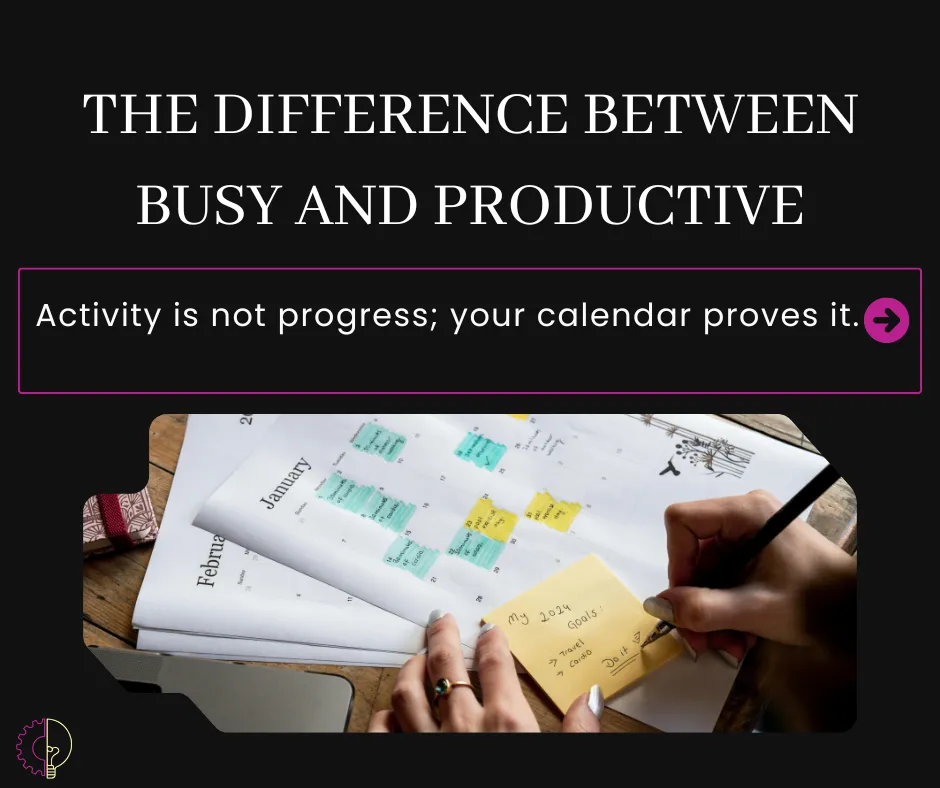
The Difference Between Busy and Productive in Your Business
"I cannot, I am busy." It is one of the most common phrases in business. It is also one of the most accepted ones. There is a particular kind of founder who has learned to wear a packed calendar like a credential. The kind whose schedule produces an audible gasp from anyone who catches a glimpse of it. Back-to-back blocks, no white space, not a single unscheduled hour. It reads like proof of something.
The question worth asking is: proof of what, exactly?
This is a pattern that shows up constantly with founders past the six-figure mark who are scaling. The calendar is full. The inbox is active. Energy is being spent. But the business is not actually moving forward. It is being maintained. There is a difference, and most founders do not catch it until exhaustion forces the question.
The pattern has a name: activity capture. A business that has grown complex enough generates a constant stream of incoming tasks — messages, decisions, requests, approvals. Without a system to filter them, everything feels equally urgent. So the response is to handle everything. To stay in motion. And motion starts to feel like progress because the alternative, slowing down to think strategically, feels like falling behind. It is not falling behind. It is the only way out.
So, before anyone clicks that "add to calendar" button, including a VA acting on your behalf, two questions deserve honest answers.
The first is opportunity cost. Every calendar block represents a choice, and every choice has a cost. Opportunity cost is the value of the option that was not selected. It is not recorded in financial statements, and it rarely shows up in a debrief. But it compounds quietly in the background every time a strategic conversation gets bumped for an administrative one, every time deep work loses to a status meeting, every time the urgent crowds out the important. A full calendar does not mean the right things are being prioritized. It means everything got a time slot.
The second is social capital. Not every meeting is a transaction, and not every room is worth being in. Social capital is the value generated through relationships, networks, and the trust built by showing up consistently in the right places. The question is not whether a meeting is busy-worthy. The question is whether it is building something. Business is not purely transactional. The relationships built in the right rooms compound in the same way opportunity cost does. The difference is in which direction they compound.
A calendar audit through these two lenses tends to produce the same result: a significant portion of what felt non-negotiable becomes negotiable very quickly. And the space that opens up is where actual strategic work lives.
If you are reading this at the end of a full day that produced very little, that is information, not a character flaw. It means your operations have not caught up to your growth yet. That gap has a structural solution.
A free 30-minute clarity call is available through SmoothOps Solutions. We will look at where the breakdown is actually happening and what it would take to change it. Book directly at smoothopssolutions.com.